"America's Best Sedan" 2020 Honda Accord Heading to Dealerships
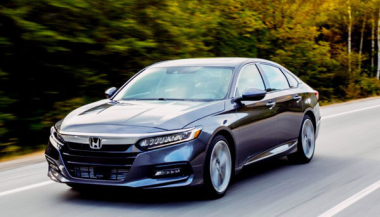
• Accord continues to offer award-winning combination of performance, comfort, technology and style
• Honda Sensing® standard on all trims, includes Traffic Sign Recognition
• Only midsize sedan in its class offering a manual transmission
TORRANCE, Calif., Sept. 16, 2019 -- With a choice of two turbocharged engines, standard Honda Sensing®, and a spacious and high-tech interior, the 2020 Honda Accord begins arriving at dealer showrooms tomorrow, September 17, with a starting Manufacturer's Suggested Retail Price (MSRP) of $23,8701 (excluding $930 destination and handing). The 2020 Accord Hybrid on-sale will be announced separately.
The 10th-generation Accord offers midsize sedan shoppers a combination of performance, refinement, technology, and value that has made it the winner of dozens of awards and accolades since its introduction, including 2018 North American Car of the Year. The 10th-gen Accord has been called "America's Best Sedan" by Car and Driver, and Accord is the all-time leader in the magazine's "10 Best" awards with 33 appearances on the coveted list.
2020 Accord buyers can choose between two turbocharged 4-cylinder engines: a 1.5-liter, DOHC direct-injected engine with a peak output of 192 horsepower and 192 lb.-ft. of torque (both SAE net) backed by a CVT automatic transmission, or a 2.0-liter VTEC Turbo® with 252 peak horsepower and 273 lb.-ft. of torque (both SAE net) with a 10-speed automatic. In Sport trims, both engines are also available with a 6-speed manual transmission, and Sport trims are also available in two exclusive colors: San Marino Red and Still Night Pearl. All Honda Accords for the U.S. market are manufactured exclusively at Honda's Marysville, Ohio, auto plant using domestic and globally-sourced parts.
Safety and Driver Assist Technology
Standard on every 2020 Honda Accord Honda Sensing® suite of safety and driver-assistive technologies that includes Collision Mitigation Braking System™ (CMBS™) with pedestrian sensing, Lane Keeping Assist, Adaptive Cruise Control with Low-Speed Follow and Traffic Sign Recognition (TSR). Also standard are automatic high-beam headlights, a Multi-Angle Rearview Camera and a driver attention monitor, while additional available driver-assistive features include blind spot information (BSI) and rain-sensing windshield wipers.
Thanks to its next-generation Advanced Compatibility Engineering™ (ACE™) body structure and advanced safety systems, Accord achieves a 5-star Overall Vehicle Score from the NHTSA in its NCAP safety ratings, and is anticipated to receive a Top Safety Pick rating from the Insurance Institute for Highway Safety (IIHS), including the highest available IIHS rating of "Good" in all crashworthiness tests.